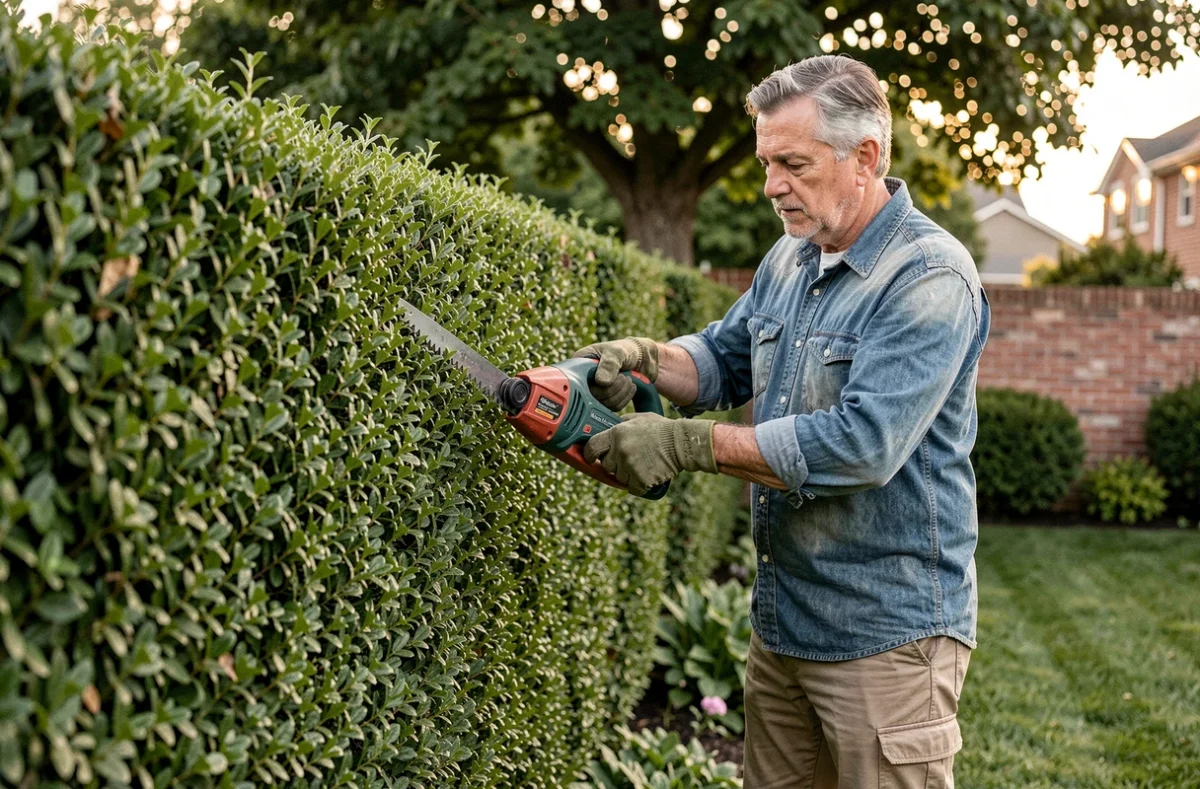
Trimming a hedge involves working on a living organism whose reaction depends on the timing, the tool, and the angle of the cut. A poorly oriented cut exposes the wood to moisture and fungi, while trimming done at the wrong time can destroy protected nests and expose one to legal penalties.
Nesting and regulations: what hedge trimming legally implies
The period from mid-March to the end of July corresponds to a recommendation from the French Office for Biodiversity to protect nesting. This is not an automatic national ban for individuals, but destroying nests or eggs of protected species remains prohibited year-round.
Prefectural orders may impose stricter local restrictions. Before taking out the hedge trimmer in the middle of the season, checking with the prefecture or town hall can avoid unpleasant surprises.
Decree No. 2026-829 of August 28, 2026, relating to the unique hedge regime gradually modifies the framework applicable to agricultural hedges. This text clearly distinguishes between the destruction of a hedge, now governed by a departmental calendar, and maintenance trimming with conservation of stumps, which remains permitted provided it does not harm protected species. Hedges that form the boundary of a garden adjacent to a dwelling are excluded from this regime.
A simple precaution before any intervention: visually inspect the hedge along its entire length. An active nest, even a small one, requires postponing the trimming of the affected area. The resources available on sculpte-haie.com help better identify suitable periods according to the species.
Cutting angle and trapezoidal profile: the geometry that conditions regrowth
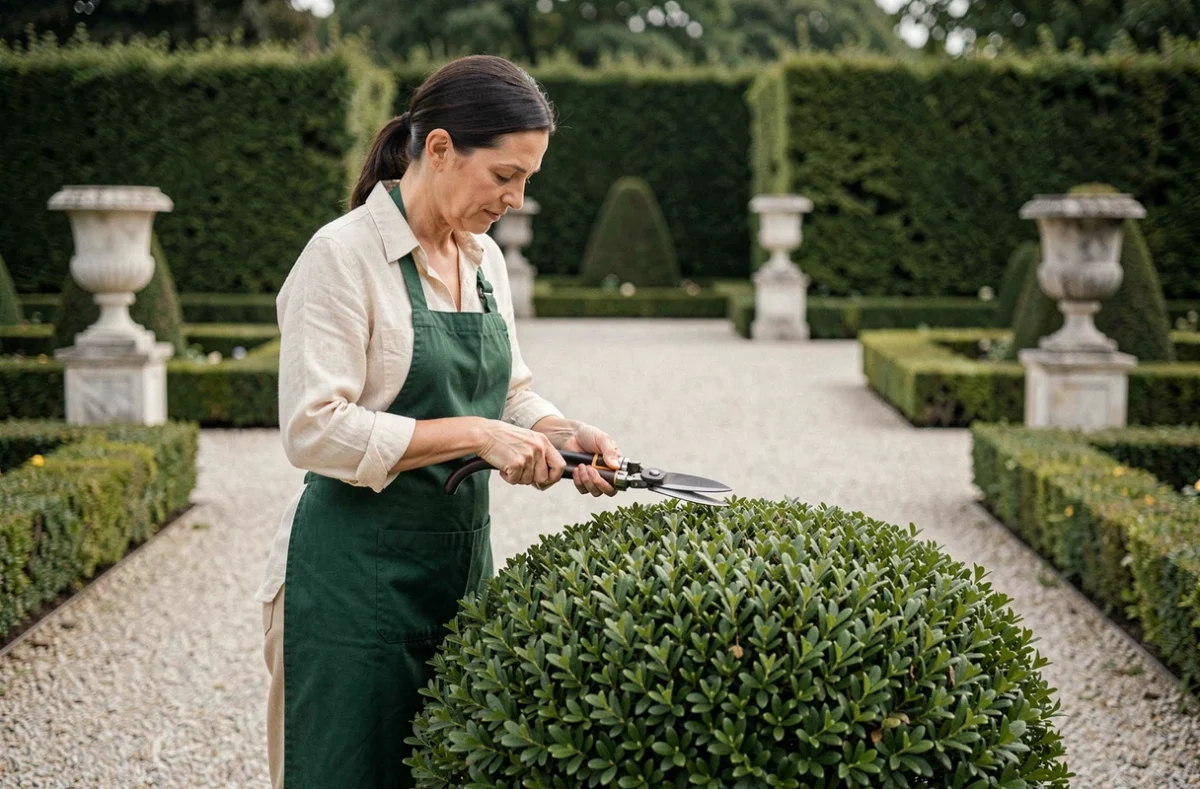
Most guides recommend to “cut straight.” In practice, the shape given to the cross-section of the hedge determines its future density and resistance to weather conditions.
A slightly trapezoidal profile, wider at the base than at the top, ensures that light reaches the lower branches. A hedge trimmed into a perfect rectangle eventually becomes bare at the base in a few seasons because the upper branches shade the lower shoots.
The ideal angle between the vertical and the side face of the hedge is around a few degrees of inclination. To achieve this profile without measuring equipment, a construction technique involves planting two stakes at the ends of the hedge and stretching a line at the desired height. The line serves as a horizontal guide, and the inclination is visually checked by stepping back two paces.
The direction of the cut also matters. On woody branches, the blade should cut at an angle, slightly above a bud facing outward. Cutting flush with the bud or too far away leaves a stub that necroses and opens a door to pathogens.
Choosing and maintaining hedge trimmer blades
A poorly sharpened tool crushes plant fibers instead of cutting them. The visible result is browning of the tips a few days after trimming. The invisible result is slowed healing that weakens the shrub.
The choice between a battery-powered electric device and a thermal model depends less on power than on three concrete criteria:
- The blade length: a short blade (around 45 cm) offers more maneuverability for sculpted shapes and topiaries, while a long blade speeds up work on straight hedges
- The spacing of the teeth: wide spacing is suitable for thick branches of shrubs like laurel or photinia, while tight spacing gives a clean cut on fine foliage like privet or boxwood
- The weight of the device: beyond a few kilos, muscle fatigue degrades precision after about twenty minutes of work at height
Disinfecting the blades with alcohol between different hedges prevents the transmission of fungal diseases from one shrub to another. Regular sharpening with a flat file, respecting the original angle of the blade, extends the tool’s lifespan and cutting quality.
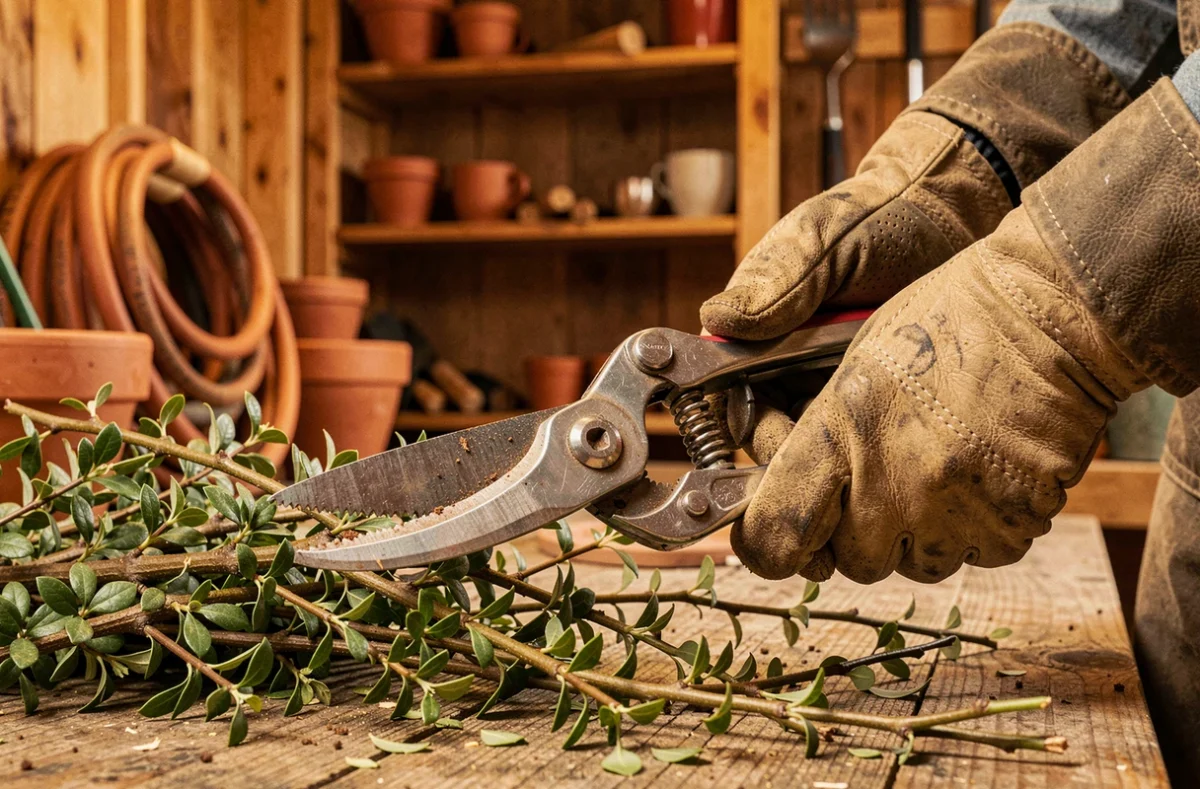
Training trim, maintenance trim, and coppicing: adapting the action to the goal
These three types of intervention are not practiced at the same time or with the same intensity. Confusing them is the main source of unbalanced hedges.
The training trim concerns young hedges during their first two to three years. It involves shortening lateral shoots to encourage branching and achieve a dense base. Without this step, the hedge grows tall but remains hollow inside.
The maintenance trim takes place on an already formed hedge, usually twice a year for fast-growing species. The goal is to maintain volume and shape without removing more than one-third of the annual vegetation. Removing more weakens the plant and causes disorderly regrowth.
Coppicing is a drastic cut, sometimes down to a few centimeters from the ground, reserved for bare or aging hedges. Not all species can withstand it: hornbeam, hazel, and privet coppice well, while conifers like thuja or Leyland cypress generally do not regrow on old wood. Coppicing on conifers often equates to the permanent destruction of the hedge.
Managing trimming waste: shred rather than dispose
The cut branches represent a substantial volume, especially on large hedges. Rather than sending everything to the waste disposal site, shredding on-site transforms these residues into usable mulch at the base of the hedge itself.
The shredded material laid in a regular layer at the base of the shrubs limits evaporation, nourishes the soil as it decomposes, and reduces the growth of weeds. Branches with a diameter larger than what a domestic shredder can handle can be cut down with pruning shears and composted separately.
A point of caution: do not shred or compost branches showing signs of disease (canker, powdery mildew, abnormal leaf spots). These waste materials should be disposed of to avoid soil reinfection.
Trimming a hedge involves both the health of the plant, compliance with an evolving regulatory framework, and a minimum of geometric rigor. Checking for the presence of nests before each intervention remains the simplest and most overlooked gesture, the one that separates a successful trim from a costly infraction.