
The French rail network draws attention whenever long-distance mobility is discussed. Buses, on the other hand, occupy a less visible segment, but their territorial network covers routes that trains do not serve, or serve poorly. Traveling by bus to discover France raises a concrete question: does this mode of transport offer a true complement to rail, or is it confined to a fallback solution for budget travelers?
Service to poorly connected areas: the bus fills a gap
Most articles about bus travel emphasize the price. While fares matter, they mask a more structural advantage: buses serve cities where trains rarely or never go. Some sub-prefectures, off-season seaside resorts, or towns in the Massif Central have only a distant train station or too infrequent rail service to facilitate a stay.
Long-distance buses can provide a feeder solution between areas where the rail network is infrequent. A bus trip between two medium-sized cities sometimes avoids a detour through a major metropolis, which reduces the overall travel time on certain routes.
To compare available connections and plan a bus journey across France, platforms like voyagenbus.com allow users to visualize the lines and connections offered by different operators.
Bus carbon footprint: a more nuanced reality than the prevailing discourse
The bus is often presented as the most environmentally friendly mode of transport after the train. Data from ADEME confirms that a well-filled bus shows a good performance per passenger-kilometer. However, an almost empty vehicle loses much of that advantage, especially compared to a car occupied by several people.
This nuance changes the perspective for travelers concerned about their footprint. Choosing a bus on a heavily trafficked route (Paris-Lyon, Bordeaux-Toulouse) ensures a high occupancy rate. On a secondary route during off-peak times, the environmental gain becomes less clear-cut.
Electrification of fleets and future prospects
Recent public policies prioritize electrification for heavy vehicles. Hydrogen, once touted as the universal solution, is now considered relevant only in specific cases, when power needs are high or access to the electrical grid is limited.
The energy transition for buses does not rely on a single technology. In the medium term, urban and suburban lines are likely to shift to electric faster than long-distance lines, where range remains a constraint.
Bus travel and slow tourism: how the pace changes
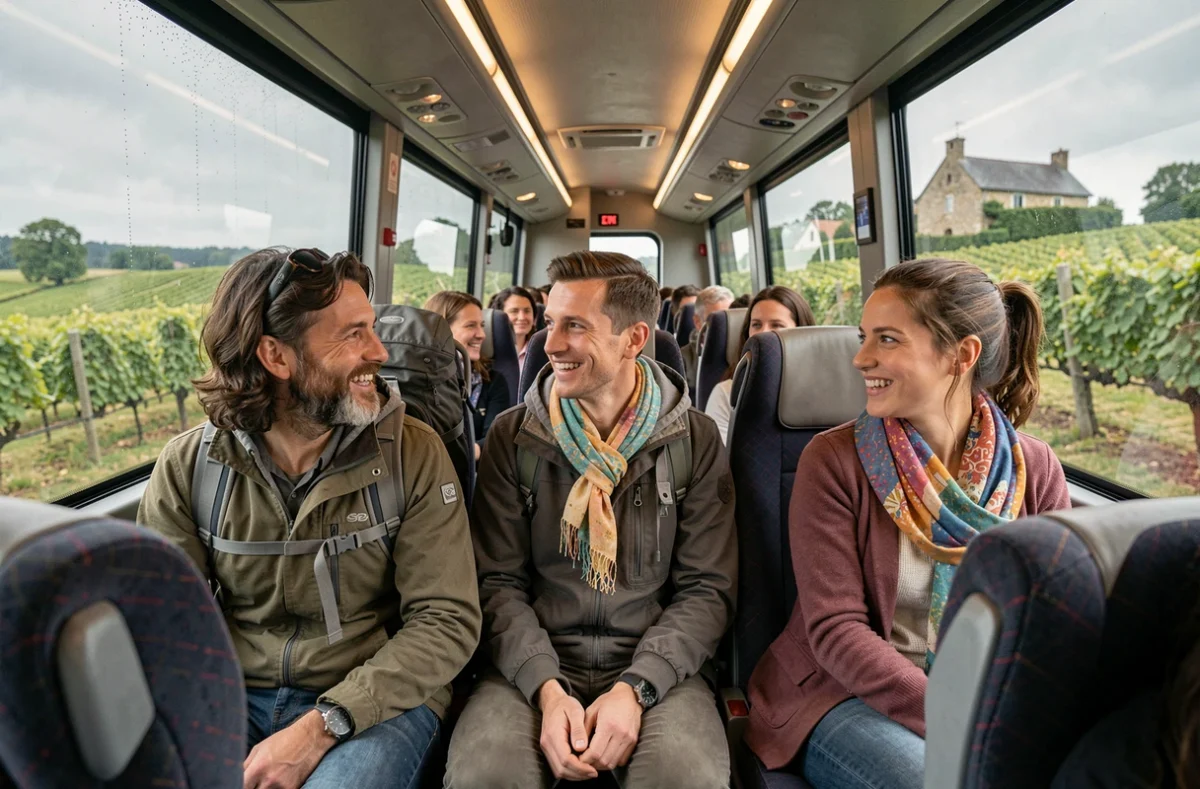
Traveling at a speed lower than that of the TGV is not just a disadvantage. The bus journey passes through landscapes visible from the road, where the high-speed train speeds between sound barriers. For tourism focused on discovering rural France, this slowness becomes a deliberate choice.
The bus also imposes a different relationship with time. Without the possibility of stopping at every intermediate station, the traveler plans their stops differently. This pace suits certain vacation profiles:
- Circuit trips between several medium-sized cities, where each stop lasts one or two days, without time pressure
- Group travel, where sharing the same vehicle creates a continuity that train connections fragment
- Destinations accessible only by road (mountain villages, natural sites far from train stations)
The bus transforms the journey into an integral part of the trip rather than a simple transfer between two points.

Real cost of a bus trip: beyond the ticket price
The displayed fare for a long-distance bus ticket is generally lower than that of the train for the same route. This price difference widens further for group travel, where chartering a bus spreads the cost among all passengers.
The calculation deserves refinement. A bus trip often takes longer than by train, which can incur additional expenses:
- An extra meal if the journey extends over half a day
- An additional hotel night when a late arrival prevents enjoying the destination on the same day
- The cost of a taxi or local transport if the bus station is far from the city center
The bus remains the cheapest mode for trips between medium-sized cities, especially when a direct rail connection does not exist and requires an expensive transfer.
Regulatory framework and reserved lanes: what is changing for buses
The French framework now allows certain lanes to be reserved for public transport and carpooling, particularly near low-emission zones. These adjustments can improve the regularity of buses on suburban sections, where traffic jams usually extend travel times.
Access to dedicated lanes reduces one of the main criticisms of buses: their lack of punctuality when entering urban areas. Field reports vary on this point depending on the routes, but the regulatory trend is towards better fluidity for road public transport.
The gradual greening of fleets, combined with these infrastructure advantages, places buses on a path of improvement. The bus will not replace the train on major routes, but it complements the rail network on connections where no other collective option exists. To discover France differently, choosing the bus is less about a budget compromise and more about a different approach to travel, where the journey itself is part of the experience.