
The persimmon rarely causes a classic IgE allergy, but the reactions it triggers are underdiagnosed and often confused with other mechanisms. Before excluding this fruit or reintroducing it, we recommend distinguishing between sensitization, true allergy, and cross-reactivity, three situations that require different management.
Sensitization to persimmon and confirmed allergy: two distinct realities
A positive skin test or the detection of specific IgE directed against persimmon indicates sensitization. Sensitization alone is not enough to diagnose an allergy. We regularly observe patients with specific IgE who consume persimmon without any symptoms.
A reliable diagnosis relies on the intersection of three elements: clinical history (reproducible symptoms, time of onset, amount ingested), results from targeted tests, and, if necessary, an oral provocation test in a medical setting. This test involves administering progressively increasing doses under supervision, with explicit criteria for stopping. It should never be attempted at home.
At this stage, it is useful to consult the health advice from Carnet Bpco to delve deeper into the issue of allergens related to persimmons.
A common pitfall: attributing a reaction to persimmon that is due to another mechanism. Oral discomfort after consuming an unripe fruit may be related to astringent tannins, not an immune response. The time of onset and reproducibility of symptoms guide the diagnosis.

Cross-reactivity of persimmon with latex and tree nuts
The persimmon belongs to the group of fruits involved in the latex-fruit syndrome. Individuals allergic to natural latex have an increased risk of cross-reactive reactions with several tropical and subtropical fruits, including persimmon, banana, avocado, and kiwi.
The mechanism is based on structurally similar proteins (notably class I chitinases) present in both the latex of Hevea brasiliensis and the pulp of these fruits. In a patient allergic to latex, the ingestion of persimmon can therefore trigger symptoms ranging from oral syndrome (lip pruritus, oral edema) to more severe systemic reactions.
- Individuals allergic to latex should report this allergy before introducing persimmon into their diet.
- Oral allergic syndrome (tingling, oral itching) usually appears within minutes of ingestion and should not be trivialized.
- Cooking persimmon may reduce the allergenic potential of certain heat-labile proteins but does not guarantee the absence of reaction in highly sensitized individuals.
A recurrent oral syndrome after consuming persimmon warrants a complete allergy assessment, including screening for latex allergy.
Panel tests and risks of unjustified food avoidance
Allergy assessments conducted in the form of broad panels (simultaneous measurement of IgE against several dozen foods) pose a concrete clinical problem. An isolated positive result for persimmon, in the absence of symptoms, does not justify avoidance.
Recent recommendations favor tests guided by symptoms rather than indiscriminate searches. We observe that broad panels often lead to unnecessary exclusion diets, particularly in atopic patients whose immune profile easily produces multiple IgE without clinical translation.
The impact is not trivial: excluding persimmon (and by extension other fruits) without a solid medical reason impoverishes the diet in fiber, antioxidants, and micronutrients. In children, these exclusions can compromise dietary diversification.
When the oral provocation test becomes necessary
The oral provocation test remains the reference examination to differentiate between clinically silent sensitization and true allergy. It is indicated when the clinical history is ambiguous or when skin and blood tests yield discordant results.
A negative provocation test allows for the safe reintroduction of persimmon. This information radically changes management: instead of a lifelong exclusion, the patient regains a food they can consume normally.
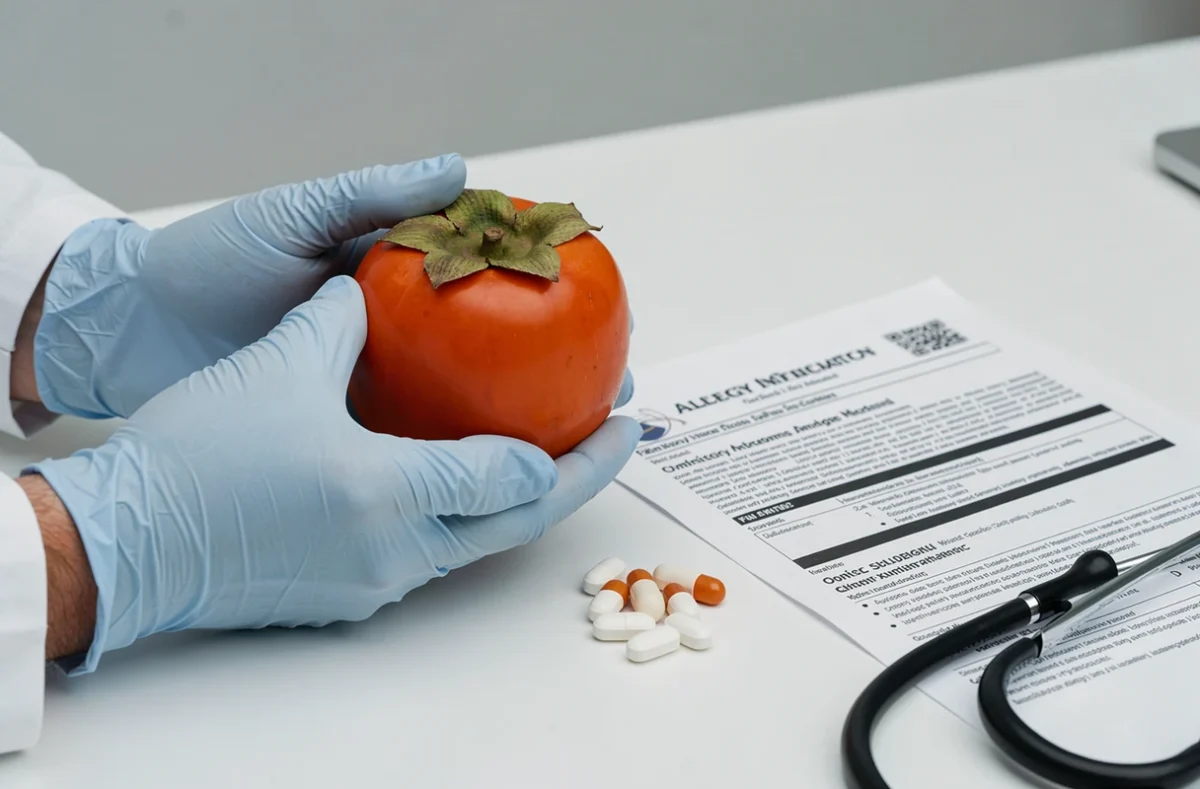
Persimmon and non-allergic symptoms: what tannins cause
The majority of unpleasant reactions after consuming persimmon are not due to an allergy. Astringent varieties contain soluble tannins in high concentrations when the fruit is not fully ripe. These tannins precipitate salivary and mucosal proteins, causing an intense dry mouth sensation, sometimes mistakenly interpreted as an allergic reaction.
In individuals with a fragile digestive system, consuming insufficiently ripe persimmon can also lead to gastrointestinal disturbances. These symptoms are dose-dependent and disappear with fully ripe fruit or a non-astringent variety like Fuyu.
- An astringent persimmon consumed firm almost systematically causes oral discomfort, even in a non-allergic person.
- Full ripening (translucent and very soft flesh) significantly reduces the concentration of soluble tannins.
- Non-astringent varieties can be consumed firm without triggering this reaction to tannins.
Differentiating between a reaction to tannins and an IgE allergy avoids unnecessary assessments and prolonged exclusions without immunological basis.
The most reliable approach in response to a reaction to persimmon remains to accurately document the symptoms, their time of onset, and the variety consumed before consulting an allergist. A fruit that causes unpleasant astringency is not a fruit that triggers an allergy. Confusing these two situations remains the primary source of diagnostic error in everyday practice.