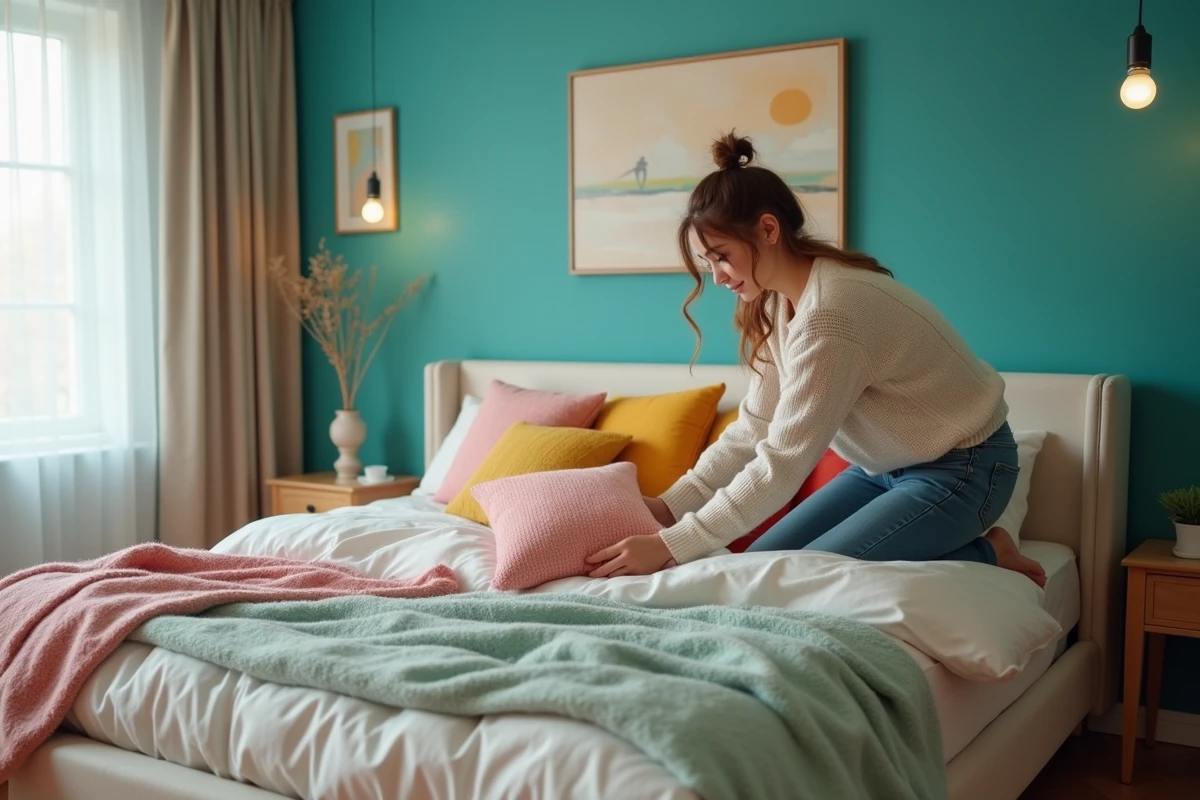
Pairing two colors in a bedroom does not guarantee balance or harmony. Some combinations, although endorsed by trends, create too stark contrasts or stifle brightness. Tradition holds that light colors enlarge a space, but unexpected choices can sometimes add more character without shrinking the room.
The placement of shades influences the atmosphere as much as their intensity: reversing the dominant and the accent transforms the overall perception. Application errors often stem from poor distribution rather than a bad choice of colors.
Why betting on two colors transforms the ambiance of a bedroom
The bedroom is far from a simple neutral space. This place protects, isolates, and soothes. Betting on two colors offers the possibility to adjust the perception of space and shape an ambiance that reflects oneself. Color is never trivial: it affects mood, modulates light, and structures the room. A predominantly light shade visually enlarges the bedroom. A dark shade, on the other hand, envelops, brings the walls closer, and creates the intimacy of a cocoon conducive to rest.
How to arrange two colors in a bedroom? The question goes beyond mere aesthetic choice: it touches on how paint separates functions, such as sleeping area, work corner, or reading space. Light, whether natural or artificial, comes into play. A well-exposed wall can tolerate a deep hue, but a dark area requires light to avoid becoming oppressive.
To better visualize the effects of a good arrangement, here’s what a well-thought-out distribution allows:
- The structure of the space is defined by the thoughtful distribution of colors.
- Light guides the choice of walls to prioritize in dark or light shades.
- Decor finds its coherence when each shade interacts with the furniture and accessories.
Color never stands alone. It adapts to the surface, orientation, and ambient brightness. Painting a bedroom in two colors is akin to orchestrating a visual score, finding that perfect balance between character and calm.
How to choose a duo of shades that truly reflects you?
To personalize a bedroom, one must consider the choice of the color duo. The shades are explored, tested, and tamed. The color wheel quickly becomes an ally: it structures reflection and illuminates compatibilities. Two main paths then open up:
- Complementary colors, opposite on the wheel, create vibrant duos. Blue and orange, green and pink, yellow and purple combine to energize the room without ever falling into monotony.
- Conversely, the monochrome plays the subtlety card by varying the intensity of the same color, for a refined and unified atmosphere.
The choice does not stop at complementarity or gradients. Warm colors like terracotta, yellow, or orange infuse energy and invite conviviality. Cool colors such as navy blue, aquamarine, or gray bring a sense of calm and freshness. As for neutral shades, beige, linen, white, taupe, they multiply light and match all desires.
Some tips to refine harmony:
- Make the furniture converse with the minority color to avoid a monochrome effect.
- Use decor to subtly recall one of the two shades and tie the whole together.
Think of the bedroom as a whole. From the wall to the bedding, from the rug to the lamp, every detail contributes to the overall balance. Adjust, correct, dare an unexpected match or a subtle shade. Coherence often arises from a well-considered choice.
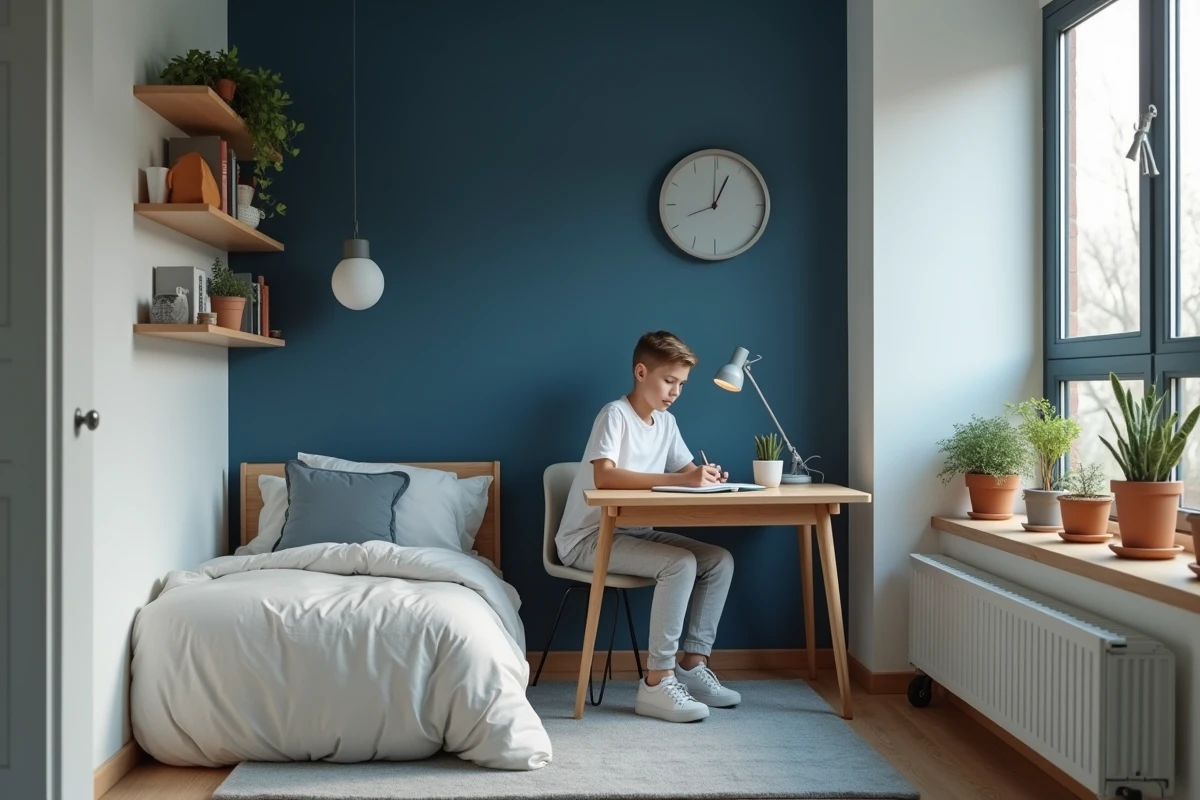
Original ideas and practical tips for stylishly arranging two colors
The accent wall remains a reliable choice for structuring the room. Painting the wall behind the headboard with the most intense or vibrant color draws attention to the sleeping area. The other walls, left light, maximize light and visually expand the bedroom. This balance, three light walls and one strong wall, avoids any overload and establishes a clear contrast that is easy to live with daily.
Want a more graphic effect? Geometric shapes bring rhythm. Horizontal stripes, arches, or triangular patterns visually separate areas without compartmentalizing. A colored wainscot, for example, highlights the furniture. Imagine an aquamarine combined with bright white to instill serenity, or terracotta paired with beige for a cozy and warm bedroom.
The 60-30-10 rule serves as a guide: 60% of a dominant color, 30% of the second, and 10% of accents through bedding, cushions, or decorative objects. This ratio provides a guideline to avoid excess and ensure coherence.
Lastly, the circulation of colors does not stop at the walls. A mustard chair placed against a navy blue background, a powder pink pendant light in a green bedroom, every combination matters. Distribute the colors, make them interact with the furniture and decor. When every detail finds its place, the bedroom gains in style and personality.
Upon waking, a well-chosen duo of colors sets the tone for the day. And in the evening, it offers a tailored setting, neither too tame nor too cluttered. The decor no longer just exists: it reflects you, simply.