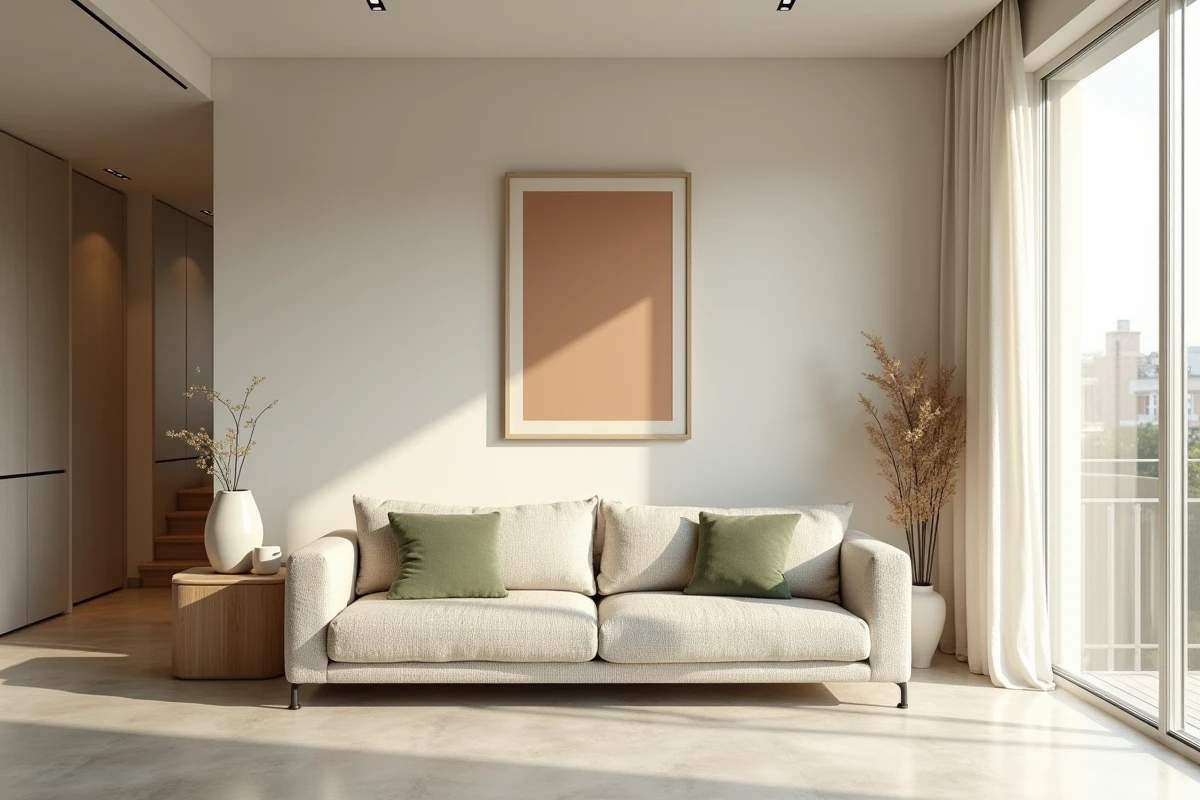
The minimalist color does not simply mean placing a terracotta cushion on a white sofa. The subject involves choices of saturation, tonal value, and spatial distribution that condition the perception of an entire volume. Here we address the technical mechanisms behind a controlled minimalist palette, beyond common inspirational advice.
Saturation and tonal value: the two parameters that define a minimalist color
A minimalist color is characterized by a low saturation combined with a medium or high tonal value. In practical terms, we work with shades whose chroma does not exceed a moderate threshold on an NCS or Munsell color chart. As soon as saturation increases, the eye perceives the color as an accent, which breaks the continuous enveloping effect sought in minimalism.
The warm minimalism that has emerged over the past few seasons perfectly illustrates this principle. Muted and enveloping palettes replace clinical white, but they remain within contained chromatic registers: greige, clay, dusty sage, muted blue. The warmth comes from the tonal value (a medium tone, neither too light nor too dark) and not from the brightness of the hue.
We recommend testing each candidate color under three distinct lighting conditions (direct natural light, diffuse light, warm artificial light) before confirming a choice. A muted shade can turn into a dirty gray under cold LED lighting, which negates the desired softness effect. The difference in rendering between a north-facing wall and a south-facing wall, in the same room, is enough to justify two different shades of the same color.
To learn more about Communiqués du Net, the definition of minimalist color is approached from a complementary angle that helps lay the foundations of the subject.
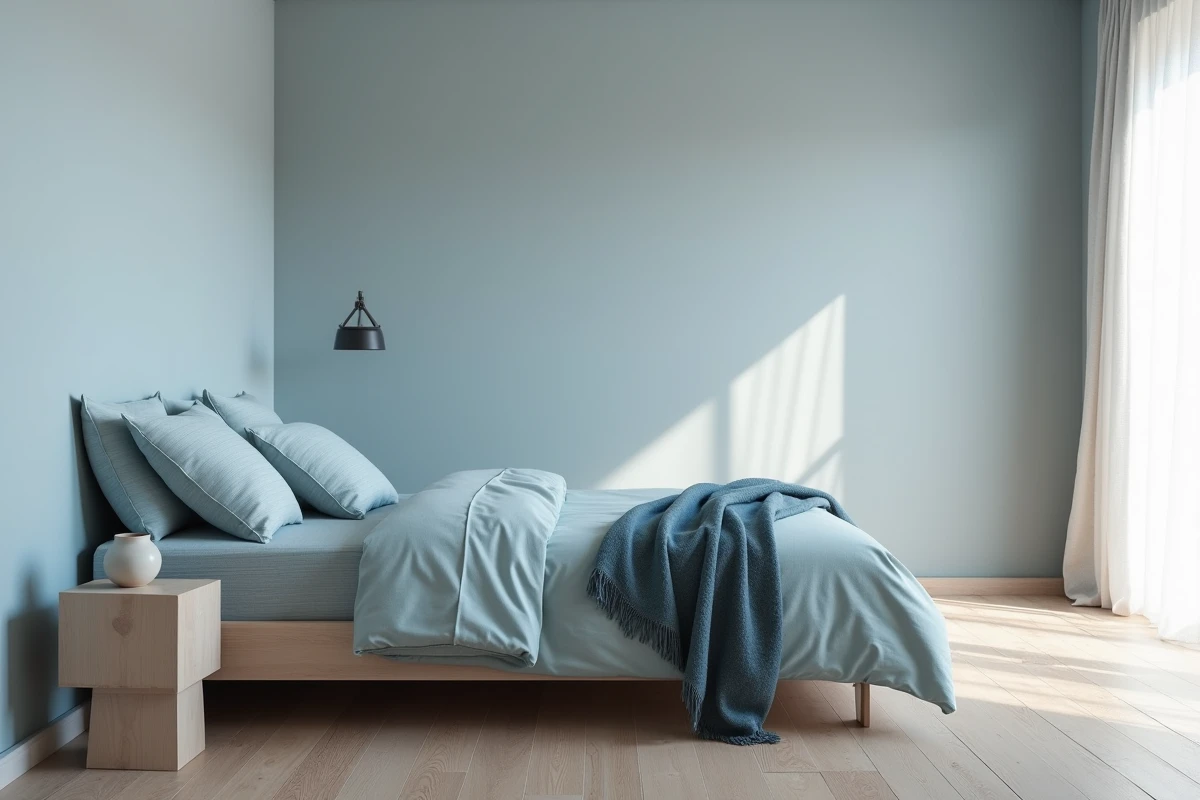
Accent wall in a dark hue: spatial impact according to ceiling height
Applying a color to a single wall remains the most common technique for injecting personality into a clean space. Decorative articles often suggest this approach without specifying that the spatial effect directly depends on the ratio between ceiling height and room depth.
A dark accent wall in a room with a ceiling lower than two meters forty will visually compress the volume. The eye interprets the dark surface as being closer, which shortens the perceived depth. In this case, we prefer a total treatment (wall + ceiling in the same hue) rather than an isolated accent: chromatic uniformity eliminates the contrast that creates the compression effect.
Conversely, in a generous volume, a deep accent wall (navy blue, desaturated forest green, chocolate brown) structures the space without reducing it. It acts as a focal plane that organizes the flow of sight.
Colored ceiling: when and how to use it
Painting the ceiling in the same hue as the walls is a radical strategy that works well in minimalism. It creates a monochromatic cocoon effect particularly suited for bedrooms and reading spaces. The technical condition: choose a matte finish for the ceiling to avoid reflections that draw attention upward and disrupt perception.
A satin finish on the walls and matte on the ceiling, in the same color reference, produces a subtle variation in brightness that adds relief without multiplying colors. Two different finishes of the same hue advantageously replace two distinct colors.
Chromatic distribution in a minimalist interior: the surface rule
Contemporary colored minimalism is no longer about placing vibrant accents on a white base. The most coherent approach relies on a hierarchy of surfaces where each element contributes to the overall palette.
- The dominant surface (walls, floor, ceiling) occupies the majority of the visual field and carries the most neutral or muted hue of the chosen palette
- The secondary surface (main furniture, structuring textiles like rugs or curtains) introduces tonal variation, not necessarily a change of hue, but a shift in value or texture
- Point elements (lighting, objects, artwork) are the only ones that can carry a more marked saturation, provided they remain limited in number
What distinguishes a well-executed minimalist interior from a simply sober space is the coherence of color temperature between these three levels. Mixing a cool bluish gray on the walls with golden oak furniture creates a visual tension that contradicts the intention of calmness.
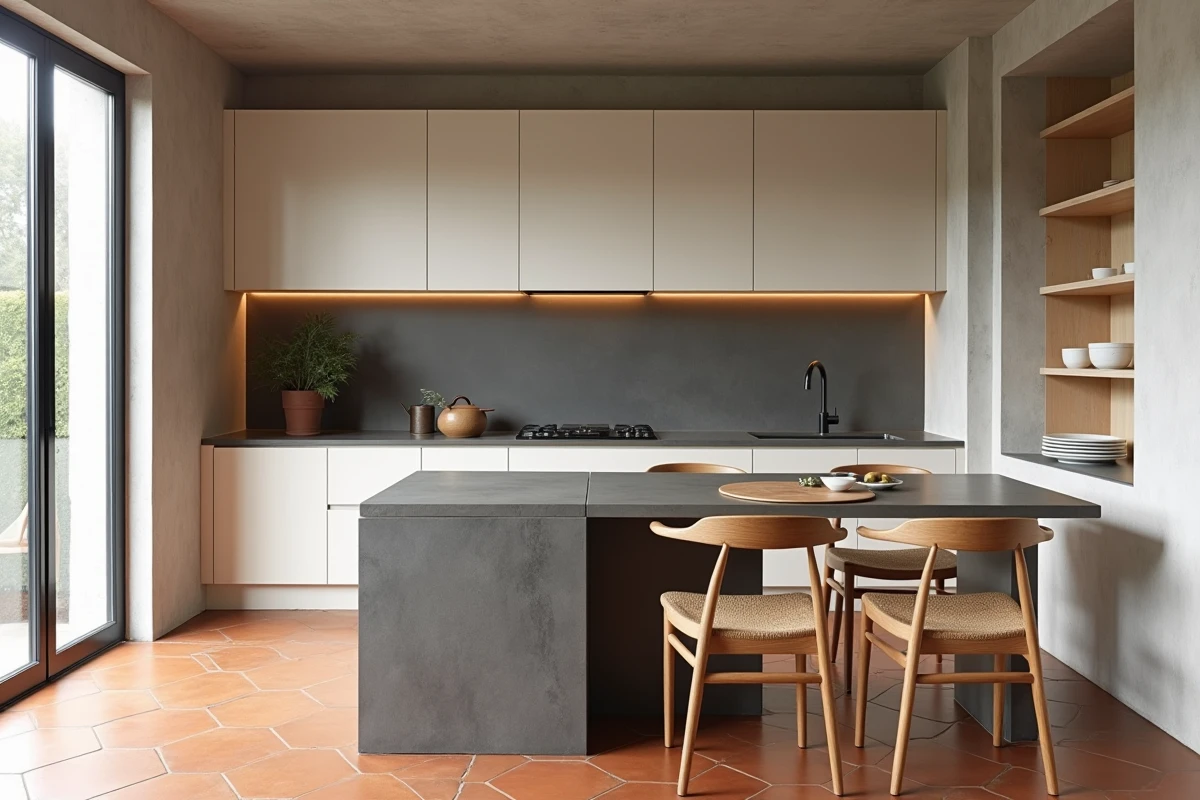
Materials and textures: the relay of color in a clean decor
When the palette is reduced to two or three close shades, texture becomes the main vector of visual richness. A lime plaster, polished concrete, washed linen, and matte stoneware can share the same chromatic range while producing radically different sensations.
We observe that the most successful minimalist interiors combine at least three distinct textures per room. Large-format stoneware, for example, provides a smooth and even surface on the floor that contrasts with a wall in irregular plaster. This tactile contrast compensates for the chromatic restraint.
- Raw or brushed wood introduces warmth without adding extra color
- Brushed metal (aged brass, blackened steel) acts as a brightness accent, not a color
- Textiles with visible weaving (linen, waffle cotton) absorb light differently depending on the angle, creating a dynamic variation in a monochromatic space
Texture is the lever that prevents a minimalist interior from tipping into monotony. A monochromatic room with five different textures appears more vibrant than a bicolored room where all surfaces are smooth.
The choice of materials also determines the durability of the palette. Muted shades applied to natural materials age better than saturated paints on synthetic substrates, which tend to yellow or lose their luster over time. A well-constructed colored minimalism gains character with the years instead of degrading.