
A battery-operated irrigation timer that drains its cells in a few weeks almost always indicates a fault in the downstream circuit, not a battery issue. Before changing brands or chemistry, one must track down parasitic current leaks that maintain a constant consumption, even when the timer is off.
Parasitic current leaks on the solenoid line
A slightly short-circuited solenoid coil, a cable nicked by a mower, or a corroded connector is enough to create a continuous current draw on the control circuit. The timer remains powered continuously, even outside of the irrigation cycle.
Toro specifies in its installation guide for the DDC WP (2023 revision) that leaks on the solenoid line significantly reduce battery life. The brand recommends a systematic measurement of the standby current with a multimeter after each installation or intervention on the network.
We recommend performing this check at least once per season. Disconnect each zone from the timer and measure the residual current. A draw of a few milliamperes in standby, where microamperes are expected, indicates an insulation fault. Find more tips to extend battery life on best practices for wiring and sealing buried connections.
Repairing the cable or replacing the connector often resolves the consumption issue without touching the batteries. This is the first diagnosis to conduct, systematically.
Battery chemistry and thermal constraints of irrigation timers
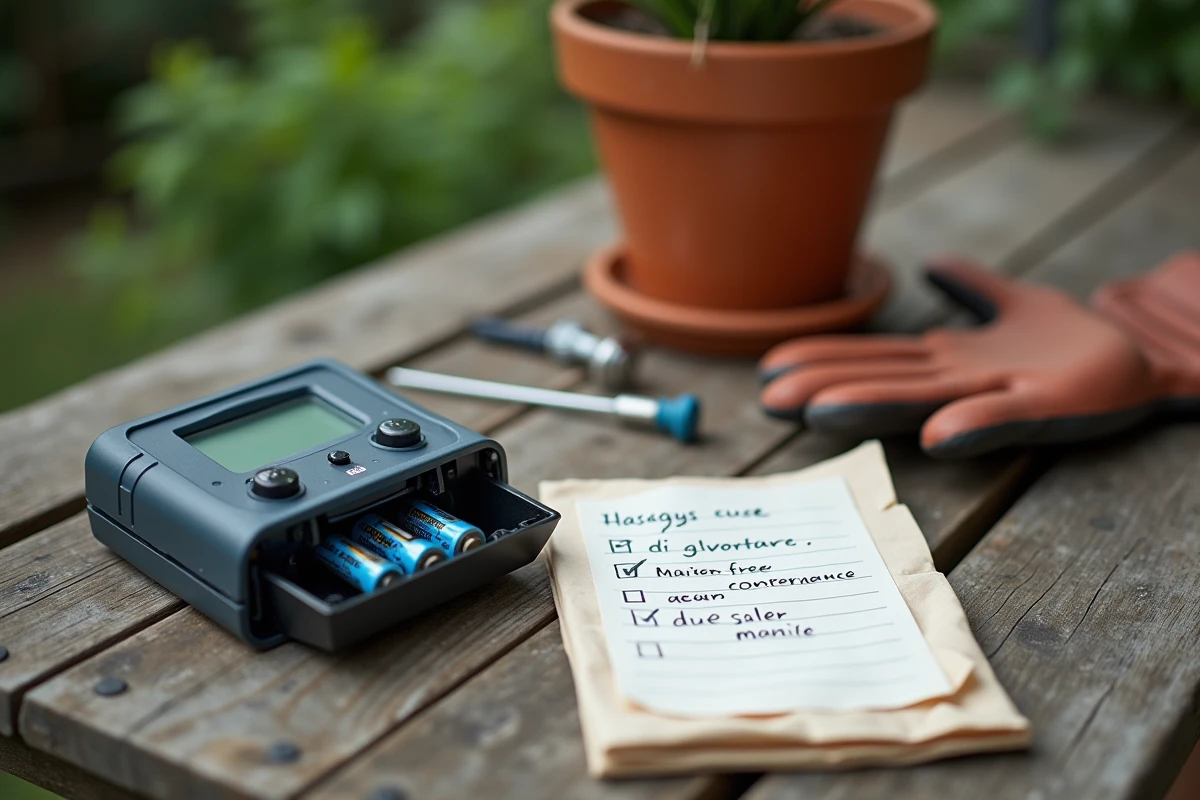
The choice of battery chemistry has a direct impact on the reliability of the timer in outdoor conditions. Recent manuals from specialized manufacturers converge on this point.
High-end alkaline batteries vs. generic models
Hunter explicitly recommends the use of high-end alkaline batteries for the NODE timer. Generic or low-end models lose a significant portion of their usable capacity at low temperatures and during pulsed discharges caused by the opening and closing of solenoid valves.
A budget alkaline battery may display the same nominal voltage as a recognized brand battery, but its internal resistance increases much faster in the cold. In practice, as soon as nighttime temperatures drop, the timer no longer receives enough current to operate the valve.
NiMH Low Self-Discharge: an alternative under conditions
Low self-discharge (LSD) NiMH batteries represent a viable option provided two conditions are met. Their nominal voltage per cell is lower than that of an alkaline battery, which requires checking compatibility with the timer’s minimum voltage threshold. Some models cut off prematurely with NiMH.
NiMH LSD batteries retain their charge better over several months than standard NiMH batteries, making them suitable for timers used for only one season. They also handle pulsed discharge cycles better than entry-level alkalines.
Watering frequency and number of activated zones
Each activation of a solenoid valve consumes a peak of current. Increasing the number of zones and daily cycles mechanically shortens battery life.
- A timer that controls a single zone twice a day puts much less strain on its batteries than a four-zone model with three daily starts per zone.
- Very short cycles (less than five minutes) are particularly energy-intensive in proportion, as the peak valve opening weighs heavily compared to the actual watering time.
- Grouping compatible zones in terms of water needs during the same time slot reduces the total number of activations and preserves autonomy.
We observe in the field that reducing the number of daily starts has more effect on autonomy than changing battery brands. Before investing in premium batteries, reconsider your watering program.

Winter storage and maintenance of the battery compartment
A timer left in place all winter with its batteries installed undergoes freeze-thaw cycles that accelerate self-discharge and promote contact corrosion.
Remove batteries off-season
Removing the batteries at the end of the irrigation season is the simplest and most effective measure. A leaking alkaline battery in its compartment leaves a white deposit (potassium hydroxide) on the metal contacts. This deposit increases contact resistance and can render the timer unusable, even with new batteries.
Clean contacts before each season
Cleaning the contacts with fine sandpaper or isopropyl alcohol before reactivation removes micro-deposits of oxidation that are invisible to the naked eye. This operation takes less than a minute and restores optimal conductivity.
- Check the condition of the sealing gasket of the battery compartment. A cracked gasket allows moisture to enter and accelerates corrosion.
- Store removed batteries in a dry place at room temperature, never in an uninsulated garage.
- Inspect the contact springs: a loose spring creates an intermittent false contact that causes repeated activation attempts and drains the batteries.
A well-maintained irrigation timer electrically lasts a full season on a set of quality alkaline batteries. The majority of premature failures we observe are due to degraded connections or overly fragmented programs, rarely a fault of the timer itself.