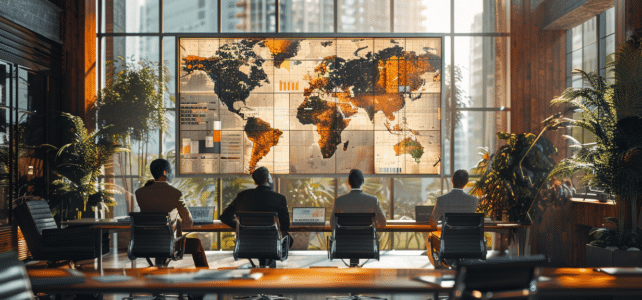
Global economic systems shape lives and societies in profound and complex ways. Each economic structure, whether capitalist, socialist, or mixed, presents unique advantages and disadvantages, influencing the distribution of resources, job opportunities, and the quality of life for citizens.
The interactions between these different systems are also crucial for understanding global dynamics. Trade exchanges, monetary policies, and economic alliances create an interconnected network where decisions made in one region can have repercussions on the other side of the globe.
Main Structures of Global Economic Systems
Capitalism, characterized by private ownership of the means of production, is distinguished by its ability to foster innovation and economic growth. This system is based on the principle of the free market, where supply and demand determine prices and production. Businesses and households play a central role, seeking to maximize their profits and respective utilities.
- Production: companies decide which goods and services to produce based on market signals.
- Labor: employment is determined by the needs of businesses and the availability of labor.
- State: intervenes mainly to regulate the market and provide public goods.
In contrast, communism proposes a collective ownership of the means of production. The state plays a predominant role, planning and directing the economy to achieve social and economic goals. Economic decisions are centralized, and the distribution of resources aims to eliminate inequalities.
Center and Periphery
The concept of center and periphery helps to understand the international division of labor. The center, composed of economically highly developed regions such as New York, London, and Paris, concentrates high value-added activities and benefits from advanced infrastructure. The periphery, on the other hand, refers to less developed territories, often specialized in low value-added activities.
- Center: developed regions, advanced infrastructure, high value-added activities.
- Periphery: underdeveloped regions, specialized in low value-added activities.
These structures influence global trade exchanges and capital flows, thus determining the overall economic dynamics. The process of growth and development is therefore uneven, shaped by the interactions between these different economic structures.

Impacts and Perspectives of Economic Systems
The shift to a sustainable development model requires a revision of current economic structures. This change aims to reconcile economic growth with the preservation of natural resources. The concept of sustainable development suggests that societies must adopt environmentally friendly economic practices to ensure sustainable resource use.
Economic sovereignty represents another fundamental aspect. It refers to a country’s ability to control its strategic resources and minimize its dependence on external factors. This economic autonomy allows for better resilience to external shocks, whether financial or geopolitical. Economic systems must therefore adapt to strengthen this sovereignty.
Theoretical Reflections
Gøsta Esping-Andersen, Raymond Aron, and Pierre-Joseph Proudhon have all studied the implications of different economic systems. Their work offers varied perspectives on the dynamics of power, production, and resource distribution. For example, the theories of Hirschman and Myrdal on center and periphery provide valuable insights into global economic inequalities.
Contemporary Challenges
Global economic systems today must address major challenges such as poverty reduction, improving the HDI (Human Development Index), and the equitable distribution of the benefits of growth. Public policies, particularly those of governments and international institutions like the World Bank and the IMF, play a decisive role in establishing frameworks that promote these objectives.
The impacts of these economic systems are vast and complex, shaping the development trajectories of nations and influencing global power relations. Future perspectives depend on the ability of economies to adapt to environmental, technological, and social changes.